Ditapis dengan

Qualitative analysis of human movement
No Inv.: 80646/P/02/1c
- Edisi
- -
- ISBN/ISSN
- 0880115238
- Deskripsi Fisik
- ix, 205 hlm.
- Judul Seri
- -
- No. Panggil
- 612.76 KNU q

Body Area Networks using IEEE 802.15.6 : implementing the ultra wide band phy…
The market of wearable wireless medical sensors is experiencing a rapid growth and the associated telecommunications services for the healthcare sector are forecast to further increase in the next years. Medical body area networks (MBANs) allow the mobility of patients and medical personnel by facilitating the remote monitoring of patients suffering from chronic or risky diseases. Currently, MB…
- Edisi
- -
- ISBN/ISSN
- 9780123965202
- Deskripsi Fisik
- iv, 44 hlm.
- Judul Seri
- -
- No. Panggil
- E1464

Co-operative and energy efficient body area and wireless sensor networks for …
With the advances in small and low-cost radio transceivers and RF front-ends development, the possibility of applying ubiquitous and non-invasive sensors integrated into user’s daily clothing and living activities seems more feasible. The ability to share data increases the usefulness of personal information devices, providing features not possible with independent isolated devices. Curr…
- Edisi
- -
- ISBN/ISSN
- 9780128007365
- Deskripsi Fisik
- vii, 51 hlm.
- Judul Seri
- -
- No. Panggil
- E1465
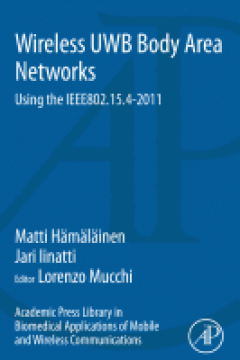
Wireless UWB body area networks : using the IEEE802.15.4-2011
Wireless sensor and body area networks (WSN and WBAN respectively) have been seen as a future way to monitor humans’ psycho-physiological signs remotely. There are a number of standards that could be used for building WBAN sytems. However, wireless UWB networks based on IEEE 802.15.4a offer the advantages of a large frequency range and low power spectral density, making it suitable for b…
- Edisi
- -
- ISBN/ISSN
- 9780128009314
- Deskripsi Fisik
- ix, 37 hlm.
- Judul Seri
- -
- No. Panggil
- E1463
Tubuh-tubuh provokatif membaca karya-karya Mochtar Apin 1990-1993
No Inv.: 102746/S/Perp/05/1c
- Edisi
- -
- ISBN/ISSN
- 9799100224
- Deskripsi Fisik
- 211 hlm.
- Judul Seri
- -
- No. Panggil
- 757 SUP t

Human physiology : an integrated approach
- Edisi
- 8th ed.
- ISBN/ISSN
- 9780134605197
- Deskripsi Fisik
- xxiii, 941 hlm. : il. warna ; 29 cm.
- Judul Seri
- -
- No. Panggil
- 612 SIL h
- Edisi
- 8th ed.
- ISBN/ISSN
- 9780134605197
- Deskripsi Fisik
- xxiii, 941 hlm. : il. warna ; 29 cm.
- Judul Seri
- -
- No. Panggil
- 612 SIL h

Junqueira's basic histology : text and atlas
- Edisi
- 17th ed.
- ISBN/ISSN
- 9781266021398
- Deskripsi Fisik
- ix, 559 hlm. : il. warna ; 28 cm.
- Judul Seri
- -
- No. Panggil
- 571.5 MES j
- Edisi
- 17th ed.
- ISBN/ISSN
- 9781266021398
- Deskripsi Fisik
- ix, 559 hlm. : il. warna ; 28 cm.
- Judul Seri
- -
- No. Panggil
- 571.5 MES j
Panduan lengkap menggambar dan ilustrasi menciptakan karakter
No Inv.: 133905/SM/Perp/13/1c
- Edisi
- -
- ISBN/ISSN
- -
- Deskripsi Fisik
- 51 hlm.
- Judul Seri
- -
- No. Panggil
- 743.4 GRA p
Lines from an artistic life : the drawings of adimoolam
No Inv.: 137169,137170/P/Perp/14/2c
- Edisi
- -
- ISBN/ISSN
- 9780853319825
- Deskripsi Fisik
- 164 hlm.
- Judul Seri
- -
- No. Panggil
- 757 KHA l
Winning body language : control the conversation, command attention, and conv…
Bibliografi : hlm. 217-220 No Inv.: 138659,138660/P/Perp/14/2c
- Edisi
- -
- ISBN/ISSN
- 9780071700573
- Deskripsi Fisik
- xix, 234 hlm.
- Judul Seri
- -
- No. Panggil
- 302.222 BOW w
 Karya Umum
 Filsafat
 Agama
 Ilmu-ilmu Sosial
 Bahasa
 Ilmu-ilmu Murni
 Ilmu-ilmu Terapan
 Kesenian, Hiburan, dan Olahraga
 Kesusastraan
 Geografi dan Sejarah